Introduction
OpenShot Video Editor is an award-winning, open-source video editor, available on Linux, Mac, and Windows. OpenShot can create stunning videos, films, and animations with an easy-to-use interface and rich feature-set.
Features
Cross-platform (Supports Linux, OS X, and Windows)
Support for most video, audio, and image formats
Drag and drop support (desktop integration)
Unlimited tracks / layers
Clip resizing, scaling, trimming, snapping, rotation, and cutting
Powerful curve-based keyframe animations (resize, scale, fade, … clips over time)
Video transitions with real-time previews
Compositing, image overlays, watermarks
Title and text creation (including 3D titles, scrolling motion picture credits)
Support for image sequences (2D animation)
SVG friendly
Advanced Timeline (including drag & drop, scrolling, panning, zooming, and snapping)
Frame accuracy (step through each frame of video)
Speed changes for clips (slow/fast, forward/backward, etc…) by time-mapping
Audio mixing and editing
Digital video effects, including brightness, gamma, hue, greyscale, chroma key (greenscreen) , and many more
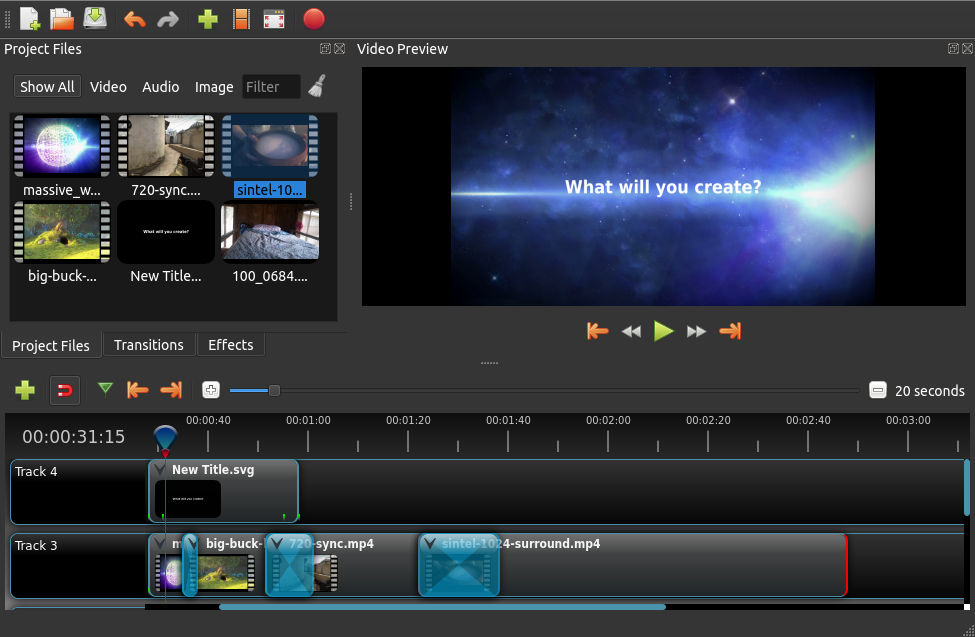
Screenshot
System Requirements
Video editing benefits from large amounts of memory, modern CPUs, and fast disks. Basically, you want the best computer you can afford when editing video. Here are the minimum system requirements:
64-bit Operating System (Linux, OS X, Windows 7/8/10)
Multi-core processor with 64-bit support
4GB of RAM (16GB recommended)
500 MB of hard-disk space for installation
Optional: Solid-state drive (SSD), if utilizing disk-caching (and an additional 10GB of hard-disk space)
Most modern computers should work well with OpenShot.
License
OpenShot Video Editor is open source Software. Software written by the OpenShot team is released under the terms of the GNU General Public License as published by the Free Software Foundation, either version 3 of the License, or (at your option) any later version, and is fully functional.
As with any major project, OpenShot uses third party libraries, which are all open source, but may be subject to slightly different licenses, as documented in the source code.
In particular the emojis license seems to require you to provide attribution, if you use these emojis.